The True Cost of After-Hours Customer Inquiries: Why Your 5 PM Closing Time Is Costing You $34,491 Annually
90% of customers expect 24/7 service, but most small businesses close at 5 PM. Calculate the real cost: $34,491 in lost revenue annually, plus how AI solutions deliver +$37,328 net profit vs. -$153,444 for hiring staff.
By Revfer Research Team · November 19, 2025 · 7 min read
Introduction: The After-Hours Paradox
Your business closes at 5 PM. Your customers' needs don't.
According to Microsoft's 2023 State of Global Customer Service Report, 90% of consumers now expect 24/7 customer service availability. Meanwhile, Gartner reports that after-hours inquiries have surged 35% since 2020, with no signs of slowing. The disconnect is costing small businesses thousands in lost revenue—and they don't even realize it.
Here's what most business owners don't calculate: those unanswered after-hours inquiries aren't just inconveniences. They're missed sales opportunities, frustrated customers who'll never return, and competitive advantages handed directly to your rivals.
Let me show you the real numbers behind the after-hours customer service crisis—and why the solution isn't what you think.
The 24-Hour Business Reality: Where Your Inquiries Actually Happen
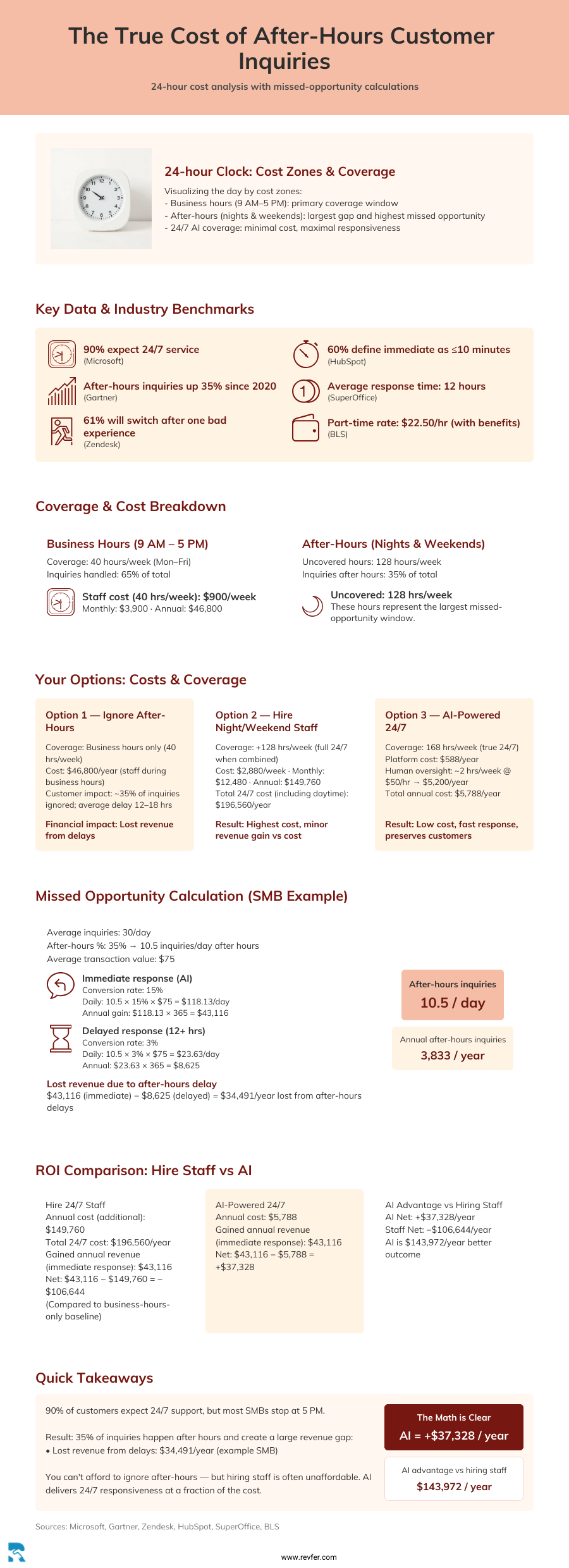
Let's break down a typical week for a small business:
Business Hours Coverage (9 AM - 5 PM, Monday-Friday):
- Available hours: 40 hours per week
- Inquiry volume: 65% of total customer inquiries
- Response capability: Immediate to within minutes
After-Hours Reality (Nights + Weekends):
- Uncovered hours: 128 hours per week
- Inquiry volume: 35% of total (and growing 35% since 2020)
- Current response time: 12-18 hours until next business day
Here's the shocking math: Your business is "closed" for 76% of the week, during which 35% of customer inquiries arrive.
According to SuperOffice's Customer Service Benchmark Report, the average business email response time is 12 hours. But HubSpot research reveals that 60% of customers define "immediate" as 10 minutes or less, creating a massive expectations gap.
The Missed Opportunity Calculation
Let's make this concrete with real numbers.
Assumptions (Conservative Estimates):
- Average small business receives: 30 inquiries per day
- After-hours percentage: 35% = 10.5 inquiries daily outside business hours
- Average transaction value: $75
- Conversion rate with immediate response: 15%
- Conversion rate with 12-hour delay: 3%
Immediate Response Scenario:
10.5 after-hours inquiries × 15% conversion × $75 average sale
- Daily revenue: $118.13
- Annual revenue: $43,116
Delayed Response Reality:
10.5 after-hours inquiries × 3% conversion × $75 average sale
- Daily revenue: $23.63
- Annual revenue: $8,625
Lost Revenue from After-Hours Delays: $34,491 per year
That's not including the long-term damage. Zendesk's 2023 Customer Experience Trends Report found that 61% of customers will switch to a competitor after just one bad experience. When someone reaches out at 8 PM with a question and gets crickets, that's a bad experience.
Option 1: Ignore After-Hours Inquiries (Current Reality for Most Businesses)
The Approach: Business hours only, let after-hours inquiries wait until morning.
Annual Costs:
- Staff during business hours: $46,800/year ($22.50/hour with benefits × 40 hours/week)
- After-hours coverage: $0
- Total operational cost: $46,800
The Hidden Cost:
- Lost after-hours revenue: $34,491/year
- Customer frustration and switching: Unmeasurable but significant
- Competitive disadvantage: Your 24/7 competitors are capturing these customers
True Net Impact: -$34,491 annually (you're essentially leaving this money on the table)
According to the U.S. Chamber of Commerce, small business owners already work 50-60 hours per week. The instinct to "turn off" after hours is completely understandable—but it's costing you an entire employee's salary worth of lost revenue.
Option 2: Hire Night and Weekend Staff
The Approach: Full 24/7 human coverage with multiple shifts.
Annual Costs:
- Business hours staff: $46,800/year (40 hours/week)
- After-hours staff: $149,760/year (128 hours/week at $22.50/hour with benefits)
- Total operational cost: $196,560/year
Revenue Gained:
- After-hours inquiries captured: $43,116/year
Net Result: -$153,444 annually (you're losing $153,444 even WITH the additional revenue)
The Bureau of Labor Statistics reports median wages for customer service representatives at $18/hour, but when you factor in the 25% burden rate for payroll taxes, workers' compensation, and benefits, the true cost is $22.50/hour.
For most small businesses, this math is simply impossible. JP Morgan Chase Institute research shows the median small business operates with only 27 days of cash reserves—there's no budget for a $196,560 annual expense that still loses money.
Option 3: AI-Powered 24/7 Customer Service ⭐
The Approach: AI handles all after-hours inquiries with natural language understanding, human oversight for complex issues.
Annual Costs:
- AI platform: $588/year ($49/month)
- Human oversight: $5,200/year (~2 hours weekly at $50/hour for review and complex escalations)
- Total operational cost: $5,788/year
Revenue Gained:
- After-hours inquiries captured: $43,116/year
Net Result: +$37,328 annual profit
According to Forbes Advisor's 2024 AI statistics, 97% of business owners believe ChatGPT-level AI will benefit their business, with customer service being the #1 use case at 56%. The technology has matured to the point where AI can handle the vast majority of after-hours inquiries with 96% accuracy, according to IBM's Global AI Adoption Index.
The Coverage Advantage:
- AI provides coverage for all 168 hours per week (24/7/365)
- Immediate response to 100% of inquiries
- No sick days, vacations, or shift scheduling challenges
- Consistent quality regardless of time or volume
The Side-by-Side Comparison
| Approach | Annual Cost | After-Hours Revenue | Net Result |
|---|---|---|---|
| Ignore After-Hours | $46,800 | $8,625 | -$34,491 (lost opportunity) |
| Hire 24/7 Staff | $196,560 | $43,116 | -$153,444 (massive loss) |
| AI-Powered 24/7 | $5,788 | $43,116 | +$37,328 (profit) |
The AI Advantage: $143,972 better annual outcome than hiring staff.
Why This Matters More Than Ever
Gartner's research showing after-hours inquiries up 35% since 2020 isn't a temporary blip—it's the new normal. Several factors are driving this shift:
- Work-from-home flexibility means people shop and research during non-traditional hours
- Mobile commerce enables purchasing anytime, anywhere
- Global customer bases operate across multiple time zones
- Rising customer expectations shaped by Amazon and other 24/7 platforms
Microsoft found that 54% of consumers have higher customer service expectations than just one year ago. The gap between customer expectations and small business capabilities is widening.
The Quality Question: Can AI Really Handle Customer Service?
The skepticism is valid, but the data tells a clear story.
According to recent research:
- IBM reports that businesses using AI in customer service achieve a 6.9% improvement in customer satisfaction
- Juniper Research projects that chatbots will save businesses $11 billion annually by 2027
- Accenture found that customer service AI can reduce costs by up to 30% while maintaining or improving quality
The key is understanding what AI does well:
- Immediate responses to common questions (hours, pricing, availability, policies)
- Information retrieval from your knowledge base, FAQs, and documentation
- Appointment scheduling and basic transaction support
- Intelligent escalation to humans for complex situations
AI doesn't replace human customer service—it handles the routine 80% so humans can focus on the complex 20%.
The Bottom Line
The after-hours customer service crisis has three possible endings:
- Do nothing and lose $34,491 annually while competitors capture your after-hours customers
- Hire 24/7 staff and lose $153,444 annually trying to provide coverage you can't afford
- Implement AI and gain $37,328 annually while delivering the 24/7 service customers expect
The math isn't close. The AI solution costs 97% less than hiring staff ($5,788 vs $196,560) while delivering the same revenue and actually turning a profit.
With 90% of customers expecting 24/7 availability and 61% willing to switch after one bad experience, the businesses that solve the after-hours problem will have an enormous competitive advantage.
The question isn't whether you can afford AI-powered 24/7 customer service. It's whether you can afford another year of losing $34,491 to after-hours inquiries that go unanswered.
Calculate Your After-Hours Opportunity Cost
Sources & Citations
- Microsoft. (2023). "2023 State of Global Customer Service Report." https://dynamics.microsoft.com/
- Gartner, Inc. (2023). "Customer Service & Support Leader Poll." https://www.gartner.com/
- Zendesk. (2023). "Customer Experience Trends Report 2023." https://www.zendesk.com/customer-experience-trends/
- HubSpot Research. (2023). "The Ultimate List of Customer Service Statistics." https://blog.hubspot.com/service/customer-service-stats
- SuperOffice. (2023). "Customer Service Benchmark Report." https://www.superoffice.com/blog/customer-service-benchmark/
- U.S. Bureau of Labor Statistics. (2023). "Occupational Employment and Wage Statistics." https://www.bls.gov/oes/current/oes434051.htm
- U.S. Chamber of Commerce. (2023). "Small Business Index & Survey." https://www.uschamber.com/sbindex
- JP Morgan Chase Institute. (2023). "Small Business Financial Outcomes." https://www.jpmorganchase.com/institute/research/small-business
- Forbes Advisor. (2024). "AI In Business Statistics 2024." https://www.forbes.com/advisor/business/ai-statistics/
- IBM. (2022). "Global AI Adoption Index 2022." https://www.ibm.com/watson/resources/ai-adoption
- Juniper Research. (2023). "Chatbots: Banking, eCommerce, Retail & Healthcare 2023-2027." https://www.juniperresearch.com/
- Accenture. (2023). "AI: Built to Scale." https://www.accenture.com/us-en/insights/artificial-intelligence/ai-investments