Are Businesses Using AI to Reply to Google Reviews? What 88,000 Reviews Show
We tracked 88,000 Google reviews of 400 local businesses from 2019 to 2026. Owners now reply to twice as many reviews, and since 2023 their replies carry the fingerprints of AI writing tools. Here is what changed, what did not, and what it means for your replies.
By Pankaj Aggarwal, Founder, Revfer · November 5, 2026 · 9 min read
Owners Reply More Than Ever. The Replies Sound Different, Too.
If you have read a few Google reviews lately, you may have noticed that more businesses are answering them, and that the answers sound a little alike. Lots of people are "thrilled". Everyone "truly appreciates" your kind words and "looks forward to welcoming you back".
We wanted to know whether that is real, so we measured it. We took a random sample of 400 local businesses in Greater Boston (100 hair salons, 100 restaurants, 100 dentists and 100 auto repair shops) and collected their full public Google review history from 2019 to 2026: 88,000 reviews and 32,500 owner replies. Then we tracked how the replies changed before and after ChatGPT launched in November 2022.
Here is what we found:
- Owners now reply to about twice as many reviews. In 2019, 27% of reviews got an owner reply. In 2026, 50% did.
- The rise started before ChatGPT. Replies were already climbing from 2019 to 2022. AI writing tools sped up an existing trend; they did not start it.
- Replies got about 65% longer, from a median of 91 characters to 150. Length was flat until 2022, then grew every year.
- Phrases typical of AI writing doubled, from about 20% of replies in 2022 to about 40% from 2024 on.
- Replies now quote the customer back. One in three repeats specific details from the review it answers, triple the 2019 rate, even when you compare replies of the same length.
- Replies did not get faster. Owners seem to use writing tools in weekly batches, not as automatic responders.
Replies Doubled, and the Trend Was Already Under Way
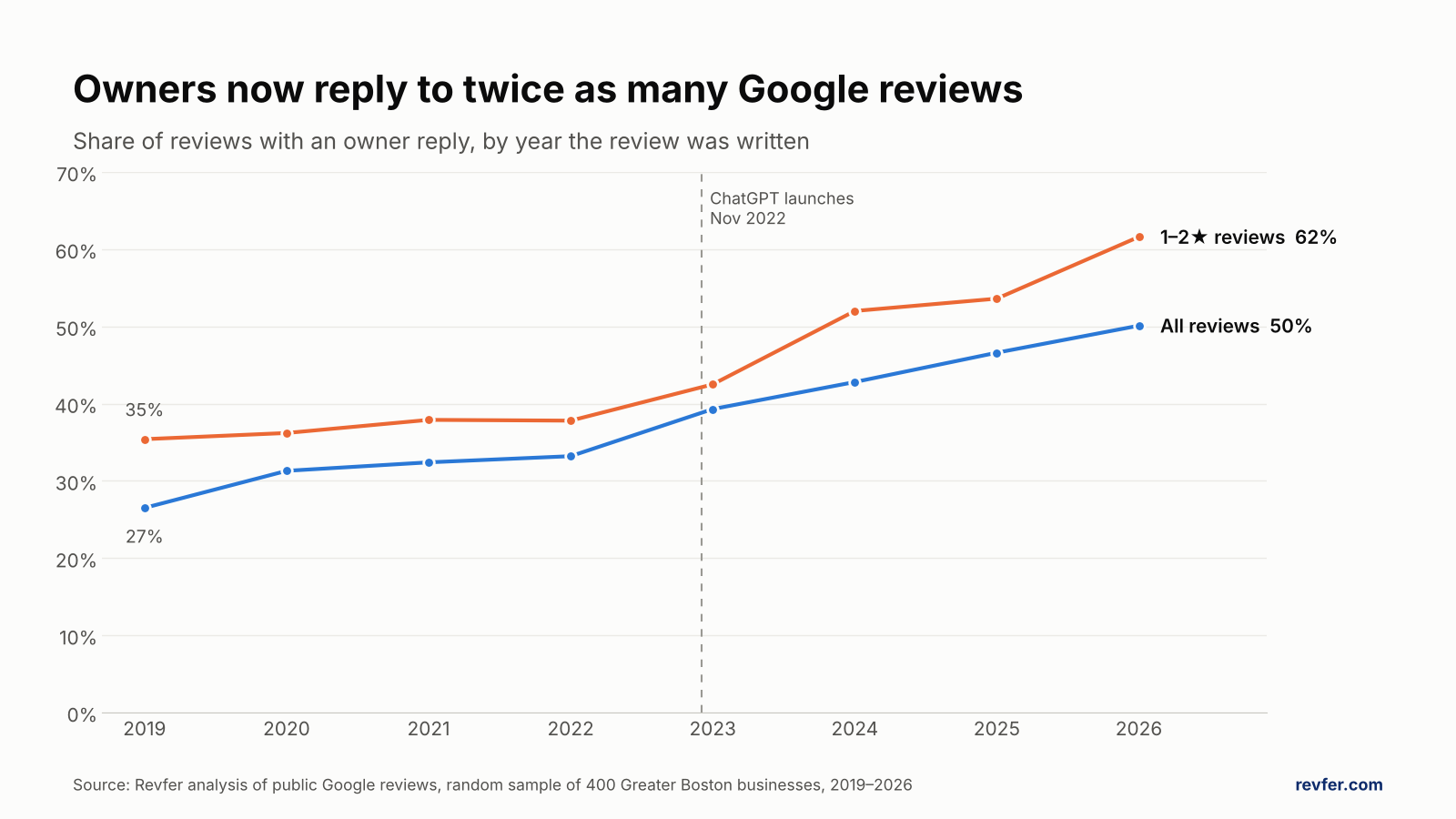
Each industry counts equally in these figures, so the busiest restaurants do not drown out the dentists.
| Review year | Reviews with an owner reply | 1–2 star reviews with a reply | Businesses that replied at all |
|---|---|---|---|
| 2019 | 27% | 35% | 38% |
| 2022 | 33% | 38% | 51% |
| 2024 | 43% | 52% | 59% |
| 2026 | 50% | 62% | 64% |
The reply rate rose by about 7 points in the three years before ChatGPT and by about 17 points in the four years after. The biggest single jump of the whole period came in 2023, the first full year after ChatGPT launched.
Replies to negative reviews jumped again in 2026, from 54% to 62%. That lines up with Google beginning to test a "Reply to reviews with AI" option in some Business Profile dashboards, first reported in March 2026. The timing fits; we cannot show that one caused the other.
The industries that used to ignore reviews caught up
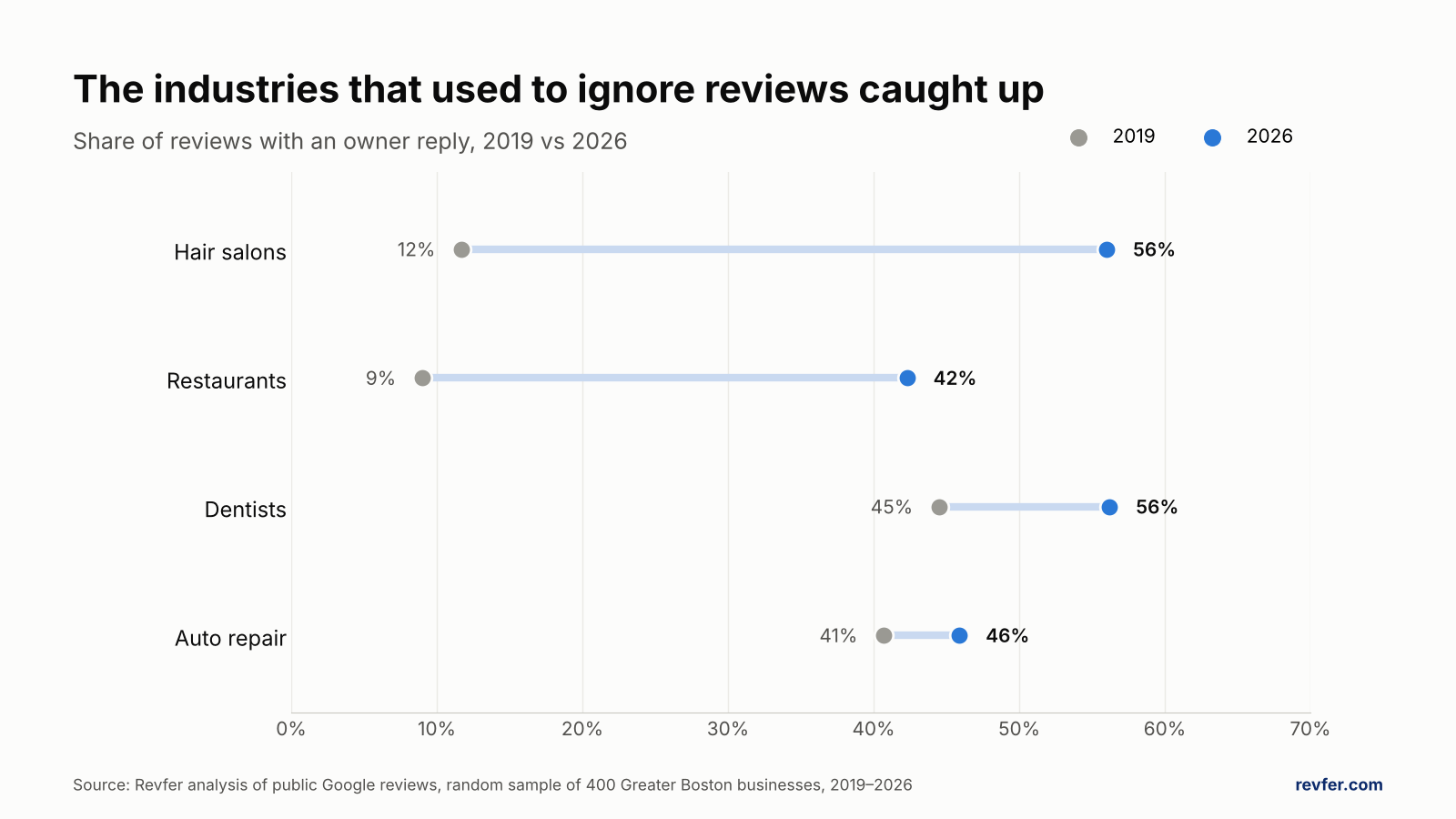
| Industry | Reviews with a reply, 2019 | Reviews with a reply, 2026 |
|---|---|---|
| Hair salons | 12% | 56% |
| Restaurants | 9% | 42% |
| Dentists | 45% | 56% |
| Auto repair | 41% | 46% |
Dentists and auto repair shops were already replying to many reviews in 2019. Salons and restaurants, which get far more reviews and have less time at the front desk, went from replying to about one review in ten to roughly one in two.
The Fingerprints: Longer Replies and a New Vocabulary
Nobody labels a review reply as AI-written, so we looked for the patterns AI writing tools are known for and checked when they appeared. None of these proves a particular reply came from a chatbot. Together, they show the style of replies changing just as these tools arrived.
Certain phrases took off after 2022
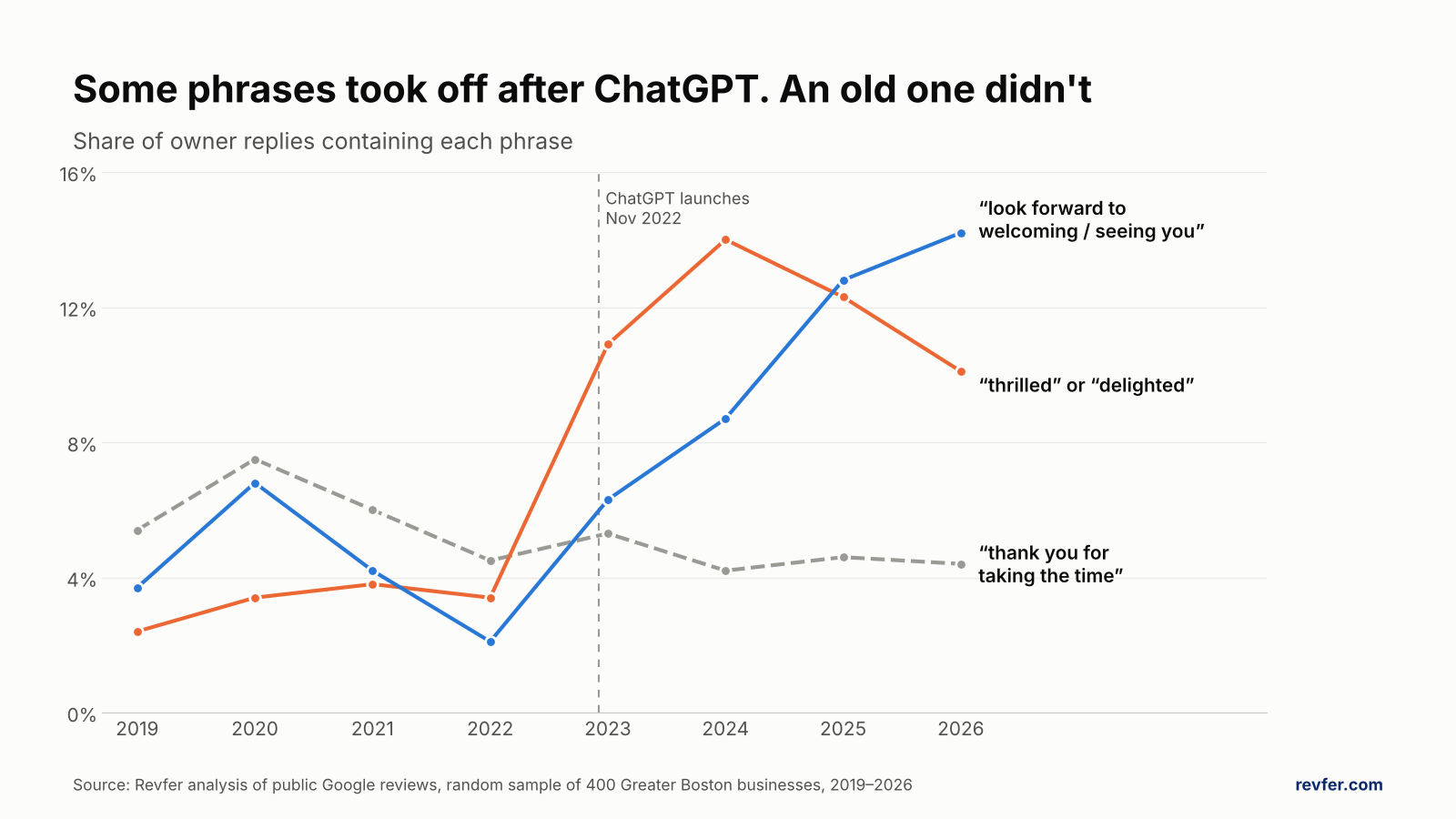
| Phrase in the reply | 2019 | 2022 | 2024 | 2026 |
|---|---|---|---|---|
| "thrilled" or "delighted" | 2.4% | 3.4% | 14.0% | 10.1% |
| "look forward to welcoming / seeing you" | 3.7% | 2.1% | 8.7% | 14.2% |
| "truly appreciate" | 0.8% | 1.8% | 2.9% | 9.5% |
| "hope to see you again" | 2.1% | 5.3% | 8.4% | 6.4% |
| For comparison: "thank you for taking the time" | 5.4% | 4.5% | 4.2% | 4.4% |
The last row matters. "Thank you for taking the time" is an old, very human phrase, and it stayed flat. So the rise is not simply owners becoming more polite. Specific phrases surged, and different ones peaked in different years, which fits writing tools changing their habits over time.
The words changed more broadly, too. Comparing 2024–26 replies with 2019–21, the words that rose most were means (so much), welcoming, glad, feedback, thrilled, delighted, truly, choosing (as in "thank you for choosing us"), sharing, trust and community. The words that fell were thanks, stars, rating, review, dear, please and owner. The old "Thanks for the 5 stars! – The owner" is giving way to "We're thrilled you enjoyed your visit. Your kind words mean so much, and thank you for choosing us."
A lighter one: the em dash, a punctuation mark chatbots love, appeared in 0.1% of replies in 2019 and about 6% in 2025, then dipped in 2026. Perhaps some owners now delete it before posting. That part is a guess.
The strongest sign: replies now repeat what the customer said
The clearest change is what we call echo: a reply that repeats specific words from the review it answers. For example (an invented one), a review that praises "the gnocchi and our server Maya's patience" gets a reply like "So glad you loved the gnocchi, and we'll pass your kind words on to Maya." Copy-paste templates cannot do this, and busy owners rarely bothered before.
- In 2019–2021, about 11% of replies repeated at least two specific words from their review. In 2026, 33% did.
- Longer replies naturally repeat more words, so we checked replies of the same length. Among replies of 100–199 characters, echo went from 5% in 2019 to 23% in 2026.
- We also scored each reply against a different review from the same business, to see how much overlap happens by chance. The gap above that baseline more than tripled between 2019 and 2026.
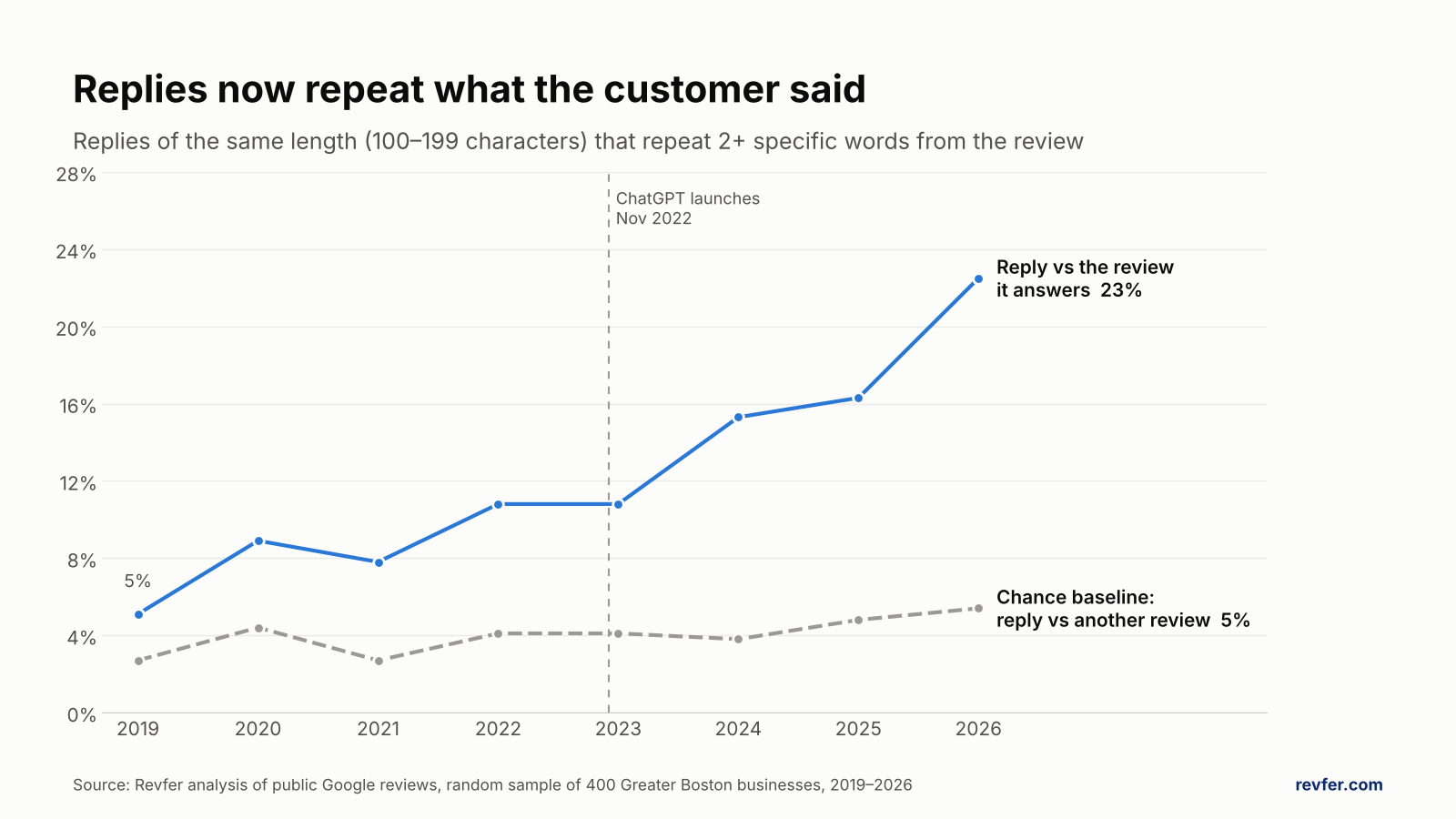
In other words, ordinary short replies now mention what the customer actually said. In 2019 only long, carefully written replies did that.
Thanking everyone, even for bare stars
Replies grew fastest on the reviews that need them least. Replies to star-only reviews, which have no text to respond to, rose from 15% in 2019 to 39% in 2026. Meanwhile, copy-paste templates became slightly less common: the share of replies that reused the same opening line within a business fell from about 21–23% to 16–19%. Owners seem to have swapped one pasted line for freshly generated text.
One more pattern, smaller but growing: replies that mention a local town the customer did not mention went from 2% of replies in 2019 to 13% in 2026. About one in five businesses that reply now does this. Some of it is simply businesses signing off with a name that includes their town.
What Did Not Change
- Speed. Among recent replies, those with AI-style phrasing took a median of 6.6 days; the rest took 5.8 days. Owners are not running instant auto-responders. They appear to sit down every week or so and work through their reviews with a writing tool.
- Old backlogs. Owners did not use AI to go back and answer old reviews. Only 2–10% of replies to 2019–2021 reviews were written after ChatGPT launched. The growth is in answering new reviews.
- Greeting by name. Replies that open with the reviewer's first name stayed at about 17–27% the whole time.
Who Is Changing?
Mostly newcomers. We followed 102 businesses that replied regularly both in 2019–21 and in 2024–26. Their replies got only 12% longer, and their share of AI-style replies rose from about 17% to 27%. A real change, but a modest one. The bigger shift comes from businesses that started replying recently: they write in the new style from day one.
What This Means for Your Replies
- Silence stands out more than it used to. When half of all reviews get an answer, and almost two in three bad ones do, an unanswered 1-star review looks worse than it did in 2019. If you reply to nothing else, reply to those. Our guide to responding to negative Google reviews has a simple method and example replies.
- Using AI is normal now. Sounding generic is the risk. "We're thrilled! We look forward to welcoming you back!" is becoming the new template, and customers learn to tune templates out. In BrightLocal's 2026 survey, half of consumers said generic or templated replies put them off.
- Be specific, the good way. The best thing AI tools brought to replies is echo: responding to what the customer actually said. Mention the dish, the stylist, the repair. That is what makes a reply read as personal.
- Edit before you post. Read the draft out loud. If it does not sound like you, change it. Cut the third exclamation mark. Make sure every fact is true: a writing tool can confidently promise things you never offered.
- Reply within a week. In most industries we looked at, the typical business that answers does so within 4 to 7 days. A steady weekly habit beats a burst of replies every few months.
AI drafts are only as good as what the tool knows about your business. See Train AI on Your Business for how to give it the right facts.
What This Looks Like With Revfer
We build an AI tool for exactly this, so here is how we think it should work. Revfer drafts a reply as soon as a new Google review lands, written in your voice and responding to what the customer actually said, using the facts you have given it about your business. You read it, change anything you like, and approve. Nothing is posted until you do, and every edit you make teaches it to sound more like you.
Reply to every review in your own voice: start free →
About Our Data
We drew a seeded random sample of Google Maps listings across 70 ZIP codes in Greater Boston and MetroWest, Massachusetts: 100 each of hair salons, restaurants, dentists and auto repair shops that were open and had at least 30 Google reviews. For each one we collected its public Google reviews and owner replies back to January 2019, fetched in October and November 2026 (about 88,000 reviews and 32,500 replies). "Industry" means how Google lists the business. Headline rates give each of the four industries equal weight; pooled figures, where restaurants dominate, show the same doubling. A business counts toward a year only if its fetched history fully covers that year. Reviews that were edited are left out of year-by-year figures, because Google shows them with their edit date. 2026 runs through late October.
Some limits to keep in mind. Every business in the sample is open today, so early years only reflect businesses that survived to 2026. Google shows reply dates only approximately ("3 years ago"), so reply speed is measured only for replies from the last few months. Phrases, echo and other patterns were measured by matching words; nobody labels replies as AI-written, so they are fingerprints consistent with AI writing tools, not proof. Echo counts a reply that shares at least two words of five or more letters with the review it answers, excluding generic words such as "great" and "service". All figures are aggregates. No business, reviewer, review or reply is identified or quoted; the example reply above is invented. Results describe this Greater Boston sample and may differ elsewhere.
Sources
- Revfer analysis of public Google reviews and owner replies of a random sample of 400 Greater Boston businesses, 2019–2026 (collected October–November 2026). See About Our Data above.
- Schwartz, B. (2026, March 24). "Google Tests Reply To Reviews With AI." Search Engine Roundtable. seroundtable.com
- BrightLocal. (2026). "Local Consumer Review Survey 2026": 50% of consumers put off by generic or templated replies. brightlocal.com
Frequently Asked Questions
Are businesses using AI to reply to Google reviews?
Many replies now look like it. In our random sample of 400 Greater Boston businesses, the share of owner replies using phrases typical of AI writing tools, such as "thrilled" or "we look forward to welcoming you back", rose from about 20% in 2022 to about 40% from 2024 on. Replies also got longer and began repeating specific details from the review. There is no reliable way to prove any single reply was written by AI, so these are fingerprints, not proof.
How many businesses reply to their Google reviews?
More than ever. In our sample, about half of all 2026 reviews had an owner reply, up from about a quarter in 2019, and 64% of businesses replied to at least one review in 2026, up from 38%. Replies to 1- and 2-star reviews rose from 35% to 62%.
Is it OK to use AI to reply to Google reviews?
Yes, as long as the reply is accurate, polite and actually responds to what the customer said. Google itself began testing a "Reply to reviews with AI" option in some Business Profile dashboards in 2026. The risk is not the tool, it is sending vague, generic text: in BrightLocal's 2026 survey, half of consumers said generic or templated replies put them off.
How can I tell if a review reply was written by AI?
You usually cannot, reliably. What we can see in the data are patterns that rose after ChatGPT launched: longer replies, certain phrases ("thrilled", "truly appreciate", "we look forward to welcoming you"), em dashes, and replies that repeat the customer's own words back. Plenty of people write that way too, so none of these prove anything on their own.
Should I reply to reviews that have only stars and no text?
A short thank-you is fine, and more businesses now do it: in our sample, replies to star-only reviews rose from 15% in 2019 to 39% in 2026. But if time is limited, answer the reviews with text first, and the negative ones before anything else.
Did AI make businesses reply faster?
Not in our data. Among replies posted in the last few months, replies with AI-style phrasing took a median of 6.6 days, compared with 5.8 days for other replies. That suggests most owners use writing tools in batches, for example once a week, rather than replying automatically the moment a review arrives.
About Pankaj Aggarwal
Pankaj Aggarwal is the founder of Revfer. He has spent more than 20 years building enterprise software and IoT systems and holds more than 10 US patents. He writes about how small businesses can put AI to work without having to become AI experts.