Wave 3 Is Here: Why 2025 Is the Most Important Year for Small Business AI Adoption — and What Happens If You Miss It
The Internet wave created millionaires who acted early and casualties who waited. The smartphone wave did the same. Wave 3 — generative AI — is moving faster than either. Here is the data on where we are, who is winning, and what the enabler platform looks like this time.
By Revfer Research Team · March 18, 2025 · 12 min read
The Pattern Nobody Is Talking About
In 1995, Jeff Bezos drove cross-country to Seattle to start an online bookstore. His logic was simple: internet usage was growing at 2,300% per year. He called it a "wake-up call." He quit his Wall Street job, built the company in a garage, and captured a wave that was just beginning.
Most small business owners in 1995 thought the internet was a fad for academics. By 2010, those businesses had permanently ceded ground to competitors who adopted early.
The same pattern played out with smartphones between 2007 and 2015. And it is playing out right now with artificial intelligence.
This is Wave 3. And the data suggests the window for early-mover advantage is closing faster than either previous wave.
Understanding the Three Waves: A Framework for What's Happening
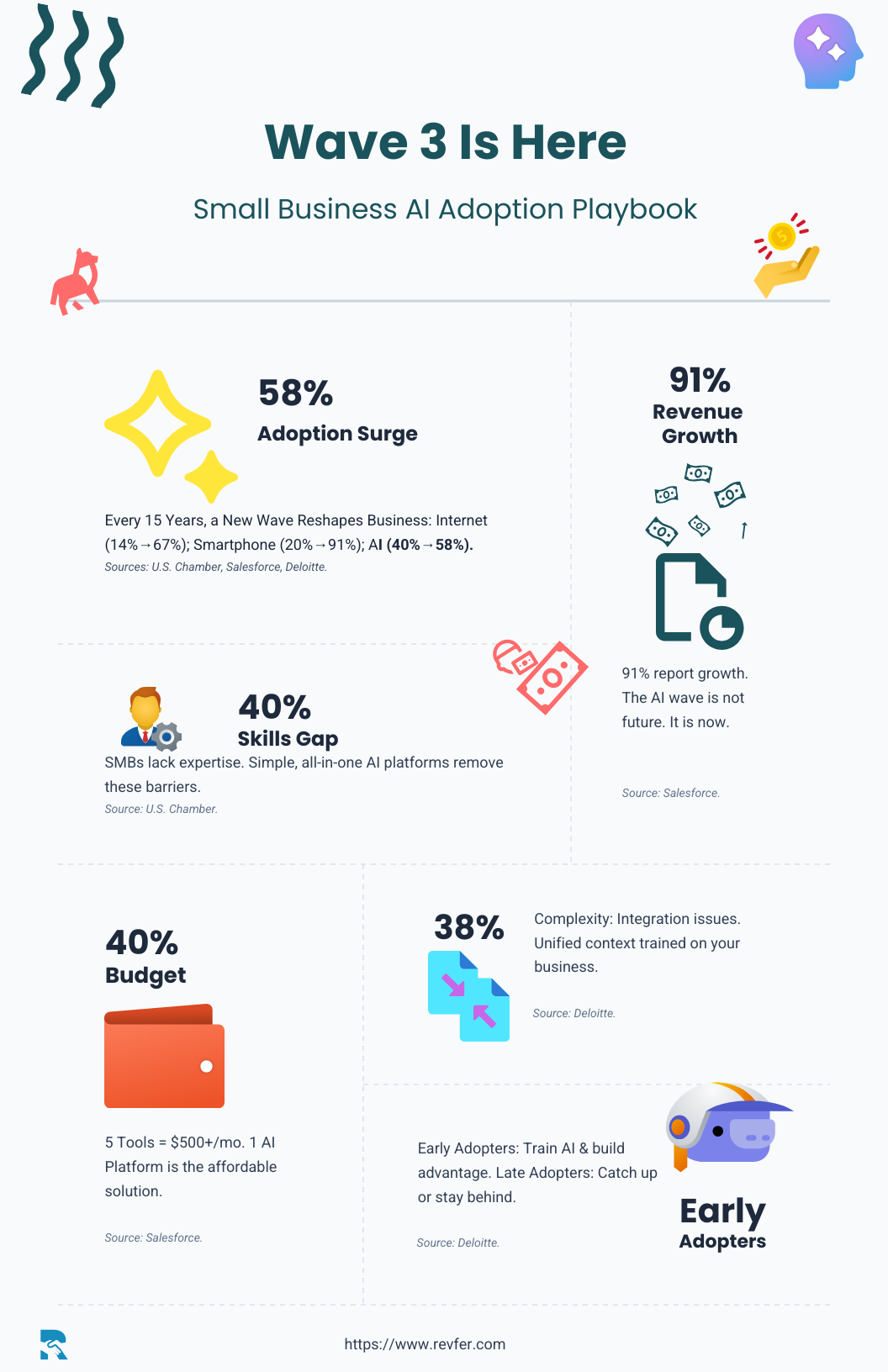
Every major technology wave follows the same arc for small businesses: enterprises adopt first, costs fall, then a platform emerges that makes the technology accessible to everyone else. The businesses that position themselves at the inflection point — when the platform arrives — capture the most durable advantages.
Wave 1: The Internet (1995–2010)
Internet usage among U.S. adults went from 14% in 1995 to 67% by 2005, according to Pew Research Center longitudinal data. But the business adoption curve lagged significantly behind consumer adoption. As late as 2010, only 50–60% of small businesses had a functioning website, according to marketing research published by the Small Business Administration.
The economic consequences were severe for laggards. McKinsey Global Institute analyzed 4,800 small and medium enterprises and found that web-intensive businesses grew revenue at twice the rate of their offline counterparts and exported twice as much. The same McKinsey research found that 75% of the internet's total economic impact flowed to traditional businesses — not technology companies — meaning the opportunity was enormous for any small business willing to participate.
The enabler that unlocked Wave 1 for small businesses: Website builders. Wix, Squarespace, and WordPress let a restaurant owner or hair salon create a professional web presence without hiring a developer or understanding HTML. The moment the technical barrier dropped, adoption accelerated. The businesses that moved in that window — that got online before their local competitors — built SEO authority, customer relationships, and review profiles that their late-moving competitors could never fully replicate.
Wave 2: The Smartphone (2007–2020)
U.S. smartphone penetration went from approximately 20% in 2010 to 91% today, according to Pew Research Center's Mobile Fact Sheet. The commercial implications were staggering. Mobile commerce now drives 73% of all global e-commerce transactions, according to MobiLoud research. App users convert 2–11x higher than mobile web visitors, and customer lifetime value is 2.8–5x higher for mobile-first customers.
Again, enterprise technology companies moved first. But the decisive moment for small businesses came when platforms — Shopify, Square, Toast, OpenTable — abstracted away the technical complexity. A restaurant could accept mobile orders without building an app. A boutique retailer could run mobile commerce without a development team. The competitive advantage went to those who adopted these platforms early, not those who waited for certainty.
The enabler that unlocked Wave 2 for small businesses: Vertical commerce platforms. These tools handled the technical infrastructure while businesses focused on what they did best — serving customers. The pattern is identical to Wave 1: technology matures, costs fall, an enabler platform arrives, and a window of competitive advantage opens briefly before the technology becomes table stakes.
Wave 3: Generative AI (2023–present)
We are now in the early-adopter phase of Wave 3. The trajectory is steeper than either previous wave.
According to the U.S. Chamber of Commerce's 2025 "Empowering Small Business" report, small business AI adoption jumped from 40% in 2024 to 58% in 2025 — an 18-percentage-point increase in a single year. Salesforce's SMB Trends research shows 96% of small business owners plan to adopt AI technologies, and 91% of those already using AI report that it boosts revenue. AI-native SaaS spending grew 75.2% year-over-year in 2025, according to Zylo's SaaS Management Index.
The wave is not coming. It is already here. The question is whether you are positioned to benefit from it or be disrupted by it.
The Data on Where Small Businesses Stand Right Now
The numbers tell a story of enormous opportunity paired with significant friction. Understanding both is essential to making the right decision about when and how to act.
The Demand Side: What Small Businesses Want from AI
AI's 2025 research on AI adoption across SMBs found that 77% of small business owners identify marketing and customer engagement as their top areas for AI deployment. Specifically:
- 84% are willing to automate content creation
- 59% want to automate customer service
- 78% of growing SMBs plan to increase AI investment this year
These are not aspirational numbers about a distant future. These are survey responses from business owners making decisions right now, in 2025.
The Supply Side: What's Available and What It Costs
Here is where the friction lives. The tools exist. But they exist as disconnected point solutions, each requiring its own setup, its own monthly fee, and its own context about the business it's supposed to serve.
WebFX's AI Pricing Survey of 250+ U.S. businesses found that AI tools cost businesses anywhere from $100 to $5,000 per month. A typical small business trying to deploy AI for customer service, content creation, social media management, and review responses would need:
| Capability | Tool | Monthly Cost |
|---|---|---|
| AI Customer Service | Tidio (Growth + Lyro AI) | $98–$149 |
| AI Content Generation | Jasper Pro | $59 |
| Social Media Management | Hootsuite Professional | $99 |
| Review Management | Birdeye Starter | $299 |
| Business Analytics | Various | $50+ |
| Total — 5 separate tools | 4–5 logins, no shared context | $555–$656/mo |
The average small business spends just $1,800 per year on AI — barely enough for one basic tool, according to research cited by CharCap. This is not a lack of interest. It is a structural problem with how AI has been packaged and sold.
The Three Barriers Blocking Small Business AI Adoption
Deloitte's CFO Survey research identifies three dominant barriers:
- Skills gap (40%): Most small business owners did not hire an AI engineer. They hired people who know their industry. Expecting them to evaluate, implement, and maintain multiple AI tools is unrealistic.
- Budget (40%): $555–$656 per month for a complete AI stack is simply out of reach for businesses operating on the median 27 days of cash reserves identified by JP Morgan Chase Institute research.
- Integration complexity (38%): Five tools that do not share data about the business produce five disconnected experiences. A chatbot that does not know what content was posted, a social scheduler that does not know what customers are asking — each tool starts from zero every time.
The Early Mover Advantage: What the Data Says About Timing
Here is the uncomfortable truth about technology waves: the advantage goes to early movers, but not to the earliest movers. The businesses that won the Internet wave were not those who tried to build websites in 1993 before the tools existed. They were those who adopted Wix and Squarespace in 2006–2010 when the tools finally made it accessible — but before their local competitors recognized the urgency.
The same dynamic is playing out with AI right now.
The Compounding Advantage of AI Context
Unlike previous technology waves, AI creates a compounding advantage that is harder to replicate over time. A business that trains an AI on its services, policies, customer FAQs, and brand voice in 2025 will have an AI that understands its business better than a competitor starting the same process in 2027.
The AI learns from every interaction. The context deepens over time. The quality of customer service responses, the relevance of generated content, the precision of analytics insights — all of these improve with accumulated context. A two-year head start in AI context is not the same as a two-year head start in having a website. It is more durable because it is embedded in the business's operational knowledge.
What "91% Say AI Boosts Revenue" Actually Means
The Salesforce SMB Trends statistic that 91% of SMBs using AI report revenue growth is remarkable — and requires interpretation. This is not a controlled experiment. These are business owners reporting their own experience of deploying AI tools. The selection bias, if anything, would understate the effect: business owners who adopted AI likely did so in areas where they expected returns.
The more instructive data points come from specific use cases:
- AI chatbots handle up to 80% of routine customer inquiries automatically, freeing owners for revenue-generating work (Invesp; ResearchGate AI Chatbot Literature Review)
- AI customer service interactions cost $0.50 versus $6.00 for human agents — a 12x cost advantage (Fullview, citing Gartner)
- AI automation saves workers an average of 3.6 hours per week — equivalent to 23 working days per year back in the owner's hands (Salesforce/Slack State of Work Report)
- Consistent social media posting — which AI makes effortless — generates 5x more engagement than sporadic posting (Buffer, Consistent Posting Study)
- Chatbots will save businesses $11 billion annually by 2027 (Juniper Research)
The Market Opportunity: What Wave 3 Is Actually Worth
Credence Research projects the global AI for Small Business market will grow from $194.6 billion in 2024 to $567 billion by 2032 — a 14.3% compound annual growth rate. North America accounts for 39% of this market, representing roughly $220 billion by 2032.
To put that in context: this is not a niche vertical. It is one of the largest technology market expansions in history. And it is centered on the 33 million small businesses in the United States alone, according to the U.S. Small Business Administration.
Zylo's 2025 SaaS Management Index reports that AI-native SaaS spending grew 75.2% year-over-year. The average SaaS spend per employee is now $8,700 per year. The businesses spending in this range on AI are not enterprises — they are mid-market and growth-stage companies that have already committed to AI as core infrastructure. Small businesses are next.
The Enabler Platform Problem: Why Wave 3 Has Been Slow for Small Business
Wave 1 needed a website builder. Wave 2 needed a mobile commerce platform. Wave 3 needs something more architecturally sophisticated — and that is why the enabler has taken longer to emerge.
The core challenge is context. A website builder does not need to know anything about your business — it just needs to let you publish pages. A mobile commerce platform needs to know your inventory. But an AI platform that handles customer service, content generation, social media, and review responses needs to know everything about your business: your services, your policies, your brand voice, your frequently asked questions, your competitive positioning.
This is why the current market — four or five disconnected point solutions — fails small businesses so completely. Each tool requires its own setup, its own context, and its own monthly fee. A chatbot that does not know what your social media team posted yesterday. A content generator that does not know what your customers are asking. Five logins, five bills, and zero shared intelligence.
The enabler for Wave 3 is a shared context layer: a single AI trained on the business once, whose knowledge then powers every capability automatically. Customer service responses that sound like the business because the AI knows its services. Content that resonates because the AI knows its customers. Review responses that are specific because the AI knows what was actually offered. Analytics that are actionable because the AI understands the business's actual performance drivers.
"One context. Every capability." That is the architecture the Wave 3 enabler requires — and it is what separates a genuine AI platform from a bundle of tools.
Who Is Already Winning Wave 3 (And the Profile of Who Gets Left Behind)
The businesses currently capturing Wave 3 advantage share several characteristics. They are not exclusively tech-forward businesses. They span restaurants, professional services, retail, healthcare, and home services. What they share is not technical sophistication — it is willingness to act before certainty.
The Early Mover Profile
- They treated AI deployment as an operational decision, not an IT project
- They started with the use case that had the clearest ROI — typically customer service automation — and expanded from there
- They accepted imperfection at launch and improved iteratively
- They did not wait for the technology to be "ready" — they recognized that "ready" is defined by when tools become accessible, not when tools become perfect
The Profile of Businesses That Get Left Behind
The historical pattern from Waves 1 and 2 is instructive. The businesses that missed those waves were not unintelligent or poorly run. They fell into one of three categories:
- Certainty seekers: They wanted proof the technology would work before committing. By the time proof arrived, the competitive window had closed.
- Cost focusers: They evaluated AI as a line-item expense rather than a revenue and efficiency driver. They calculated what it would cost without calculating what it would return — or what inaction would cost.
- Complexity overestimators: They assumed AI deployment would require technical expertise they did not have. They did not realize that the enabler platform — the Wix of Wave 3 — had arrived and made implementation accessible in 15 minutes, not 15 weeks.
The Realistic Assessment: What "96% Plan to Adopt AI" Actually Predicts
The U.S. Chamber of Commerce finding that 96% of small business owners plan to adopt AI is one of the most cited statistics in the space. It deserves scrutiny.
"Plan to adopt" is not the same as "will adopt soon." The same survey showing 58% current adoption in 2025 implies that the other 42% — many of whom also "plan to adopt" — have not yet crossed the threshold. History suggests that a significant portion of those 42% will delay until competitive pressure forces their hand.
That delay is the opportunity for businesses that act now.
In the Internet wave, the businesses that built websites in 2003 had six to seven years of SEO authority, customer data, and online review presence before their competitors who "planned to get a website" finally acted in 2010. The gap was not the technology — the technology was the same for both groups. The gap was the years of accumulated advantage.
The same dynamic applies to AI in 2025. The businesses that train an AI on their operations today will have richer context, more refined outputs, and more embedded customer relationships than those who adopt in 2027 or 2028.
The Numbers That Matter Most for Your Decision
Making the Wave 3 decision for your business comes down to three calculations:
1. The Cost of Inaction
If AI tools automate 80% of routine customer inquiries and your competitors deploy them while you do not, you are providing slower, more expensive customer service indefinitely. Microsoft's State of Global Customer Service report found that 90% of consumers expect immediate responses, and 60% define "immediate" as under 10 minutes. The businesses that cannot meet that expectation will lose customers to those that can — quietly, without a single dramatic event marking the shift.
2. The Cost of Action
An AI platform that shares context across customer service, content, social media, reviews, and analytics — implemented correctly — should cost less than any single component of the disconnected alternative. The five-tool stack runs $555–$656 per month with no shared intelligence. A unified platform runs a fraction of that with capabilities that improve over time as context accumulates.
3. The Value of Timing
This is the calculation most businesses do not make. The value of being the AI-powered business in your market before your competitors is not captured in monthly cost comparisons. It is captured in customer relationships built, reviews accumulated, brand authority established, and operational efficiency compounded over the years before your competitors catch up.
The question is not whether your competitors will eventually adopt AI. They will. The question is whether you will be the incumbent when they do — or the latecomer trying to close a gap that has been widening for years.
What Wave 3 Looks Like in Practice: Five Capabilities, One Context
The practical manifestation of Wave 3 AI for a small business is not a science project. It is operational leverage applied to the five tasks that consume the most owner time and produce the most customer-facing impact:
- AI Customer Service: Handles 80% of routine inquiries 24/7, in the business's own voice, using its actual services and policies. Not a generic chatbot — an AI that knows your business.
- AI Content Generation: Creates social media posts, blog content, and marketing copy that sounds like the business — because it was trained on the business's voice, not a generic template. Eliminates the 5–10 hours per week the average small business spends on content, according to Content Marketing Institute research.
- Social Media Management: Multi-platform posting optimized around the business's audience. Buffer research shows consistent posting generates 5x more engagement than sporadic posting — a standard most businesses cannot maintain manually.
- AI Review Responses: Professional replies to every review, grounded in what the business actually offers. Speed and consistency in review management directly impacts local SEO and customer trust.
- Smart Analytics: Real-time KPIs and business intelligence contextualized to the actual operation — not generic dashboards, but answers to questions like "why did Tuesday revenue drop?" tied to specific customer behavior patterns.
The critical architectural point is that all five capabilities share the same business context. The AI trained on your services, policies, and voice applies that knowledge everywhere — which is why the output quality improves over time and why point solutions that each start from zero cannot replicate the compounding advantage.
The Bottom Line: What History Tells Us About Right Now
Every technology wave in the past 30 years has followed the same pattern: enterprise adoption, cost compression, enabler platform, small business adoption window, competitive normalization. The businesses that moved in the adoption window captured durable advantages. The businesses that waited until normalization found themselves competing against entrenched incumbents with years of accumulated advantage.
We are currently in the small business adoption window for Wave 3.
The data is unambiguous:
- AI adoption among small businesses jumped 18 percentage points in a single year
- 91% of small businesses using AI report revenue growth
- The market will grow from $194.6 billion to $567 billion by 2032
- The barriers — cost, complexity, and skills — are being addressed by platforms that make deployment a 15-minute process, not a months-long IT project
The businesses that act in this window will look back on 2025 the way successful e-commerce businesses look back on 2005: as the year they chose to move when the movement was still optional, before it became necessary for survival.
The businesses that wait will spend years explaining to customers why their competitors respond in seconds while they respond in hours, why their competitors' content is always fresh while theirs appears sporadically, why their competitors seem to know exactly what customers want while they are still figuring it out.
Wave 3 is not a future event. It is a present one. The adoption curve is steep, the compounding advantage is real, and the window — like every window in every previous technology wave — will eventually close.
See How Revfer's Shared Context Platform Works →
Sources & Citations
- U.S. Chamber of Commerce. (2025). "Empowering Small Business: The Impact of Technology." uschamber.com
- Salesforce. (2024). "SMB Trends Report: AI and the Small Business." salesforce.com
- Zylo. (2025). "2025 SaaS Management Index." zylo.com
- Credence Research. (2024). "AI in SMBs Market — Size, Share & Forecast 2024–2032." credenceresearch.com
- Pew Research Center. (2025). "Mobile Fact Sheet." pewresearch.org
- Pew Research Center. (2014). "Internet User Demographics." pewresearch.org
- McKinsey Global Institute. (2011). "Internet Matters: The Net's Sweeping Impact on Growth, Jobs, and Prosperity." mckinsey.com
- MobiLoud. (2025). "Ecommerce Mobile App Statistics." mobiloud.com
- BigSur.AI. (2025). "AI Adoption: SMBs vs Enterprises." bigsur.ai
- Deloitte. (2023). "CFO Survey: AI Barriers in Small Business." deloitte.com
- WebFX. (2025). "AI Pricing Survey of 250+ U.S. Businesses." webfx.com
- JP Morgan Chase Institute. (2023). "Small Business Financial Outcomes." jpmorganchase.com
- CharCap. (2025). "Small Business AI Adoption Survey." charcap.com
- Invesp. (2024). "AI Chatbot Statistics: 80% of Routine Inquiries Automated." invespcro.com
- Fullview. (2025). "AI Customer Service Statistics." Citing Gartner. fullview.io
- Salesforce / Slack. (2025). "State of Work Report: AI Saves 3.6 Hours Per Week." salesforce.com
- Buffer. (2024). "Consistent Posting Study: 5x More Engagement." buffer.com
- Juniper Research. (2023). "Chatbots: $11 Billion in Annual Savings by 2027." juniperresearch.com
- Accenture. (2023). "AI: Built to Scale — 30% Cost Reduction, 38% Profitability Boost." accenture.com
- Microsoft. (2023). "2023 State of Global Customer Service Report." dynamics.microsoft.com
- Content Marketing Institute. (2023). "B2C Content Marketing Benchmarks: 5–10 Hours/Week on Content." contentmarketinginstitute.com
- U.S. Small Business Administration. (2024). "Small Business Facts: 33 Million U.S. Small Businesses." sba.gov