What Gets a Local Business Recommended by AI? We Asked ChatGPT, Gemini, Perplexity and Google 2,900 Times
We asked ChatGPT, Gemini, Perplexity and Google the same question in 40 US cities and 12 local industries. The businesses they recommend have three things in common: hundreds of Google reviews, 4.7 stars or better, and a review in the last week or two.
By Pankaj Aggarwal, Founder, Revfer · November 10, 2026 · 9 min read
Ask an AI for a Good Hair Salon. Who Does It Name?
More people now ask ChatGPT or Google's AI where to get a haircut, find a dentist or eat dinner, instead of scrolling a map. The AI names a handful of businesses and that's it. So which ones does it pick?
We tested it. We asked ChatGPT, Gemini, Perplexity and Google the same plain question, like "Can you recommend a good chiropractor in Boise, ID?", in 40 US cities and 12 local industries: 480 questions, about 2,900 answers and more than 16,000 business recommendations. For every question we also saved Google Maps' top 20 for the same search, the businesses the AI could have picked, and compared what the recommended ones have in common.
Here is what we found, as of November 2026:
- The number of Google reviews was the strongest predictor of being recommended, for every AI tool we tested. Businesses with 250+ reviews were about 6 times as likely to be named by ChatGPT as those with under 50.
- 4.7 stars is a line that matters for ChatGPT and Google's AI. At the same number of reviews, businesses at 4.7★ or higher were about 2 to 4 times as likely to be named. Gemini and Perplexity cared much less about stars.
- Recent reviews matter. A business whose latest review was under a week old was about 12 times as likely to be named by ChatGPT as one whose latest review was a year or more old.
- More than half of the businesses in Google Maps' top 20 were never named by any AI tool. The ones that were looked very different, even though their star ratings were the same.
- Replying to reviews, photos and booking links mattered little once reviews were accounted for. Having a website mattered for Gemini.
One important note before the details: this shows which businesses get named, not why. We didn't change anything and watch the result. So read every finding as "the businesses AI recommends look like this", not "do this and AI will recommend you".
1. Reviews: The More, the Better, Up to About 250
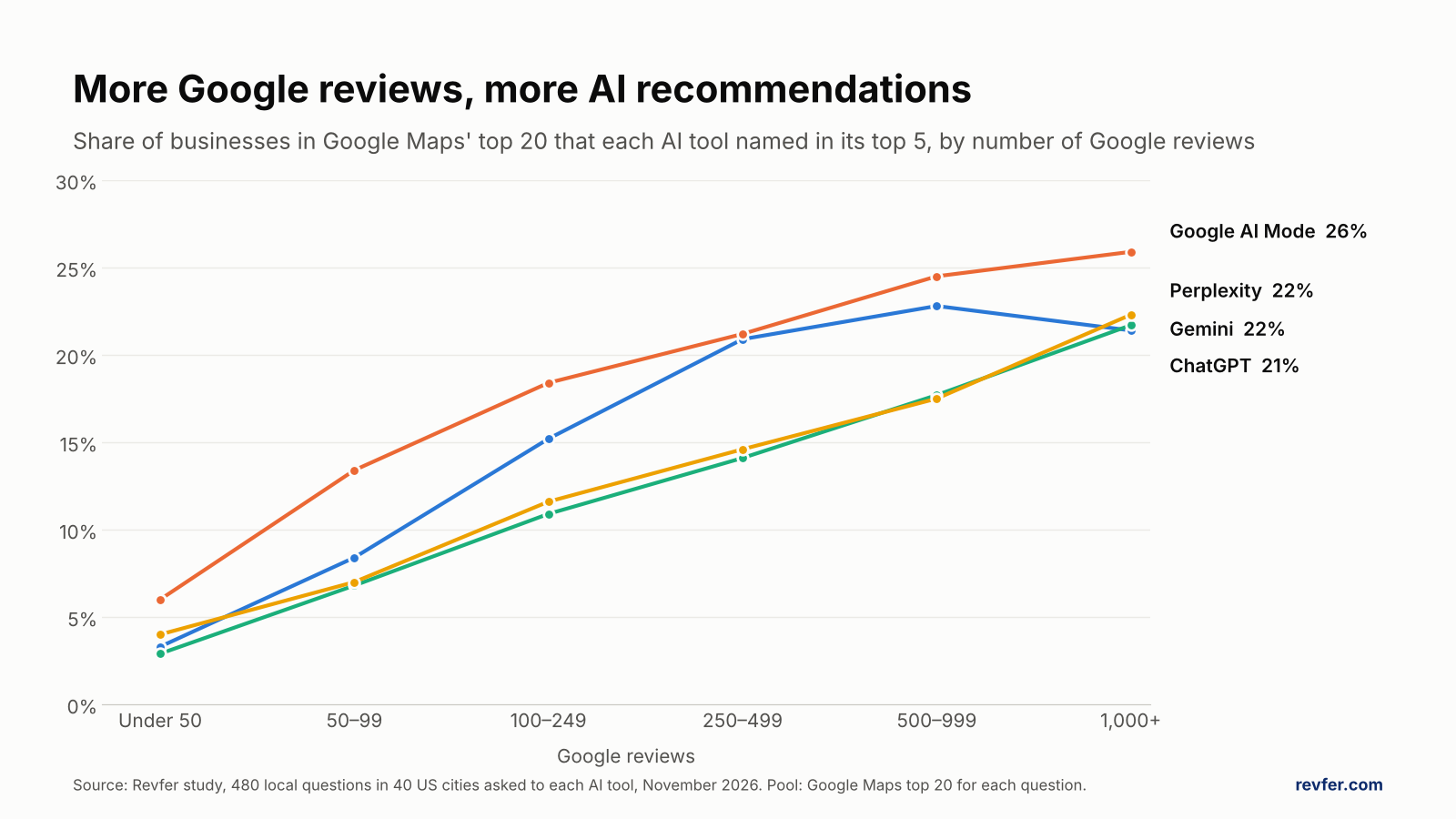
| Google reviews | ChatGPT | Google AI Mode | Gemini | Perplexity |
|---|---|---|---|---|
| Under 50 | 3.3% | 6.0% | 2.9% | 4.0% |
| 50–99 | 8.4% | 13.4% | 6.8% | 7.0% |
| 100–249 | 15.2% | 18.4% | 10.9% | 11.6% |
| 250–499 | 20.9% | 21.2% | 14.1% | 14.6% |
| 500–999 | 22.8% | 24.5% | 17.7% | 17.5% |
| 1,000+ | 21.4% | 25.9% | 21.7% | 22.3% |
For ChatGPT, the chance of being named climbed steeply up to about 250 reviews and then levelled off. For Gemini and Perplexity it kept rising all the way past 1,000. Businesses with more reviews tend to be better in other ways too, so we also used a statistical model that compares each business only with its competitors for the same question and holds the other features fixed. Review count was still the strongest predictor for every tool: a business with about 3.4 times as many reviews as a competitor had about 1.9 to 2.4 times the odds of being named.
2. Stars: 4.7 Is the Line for ChatGPT and Google
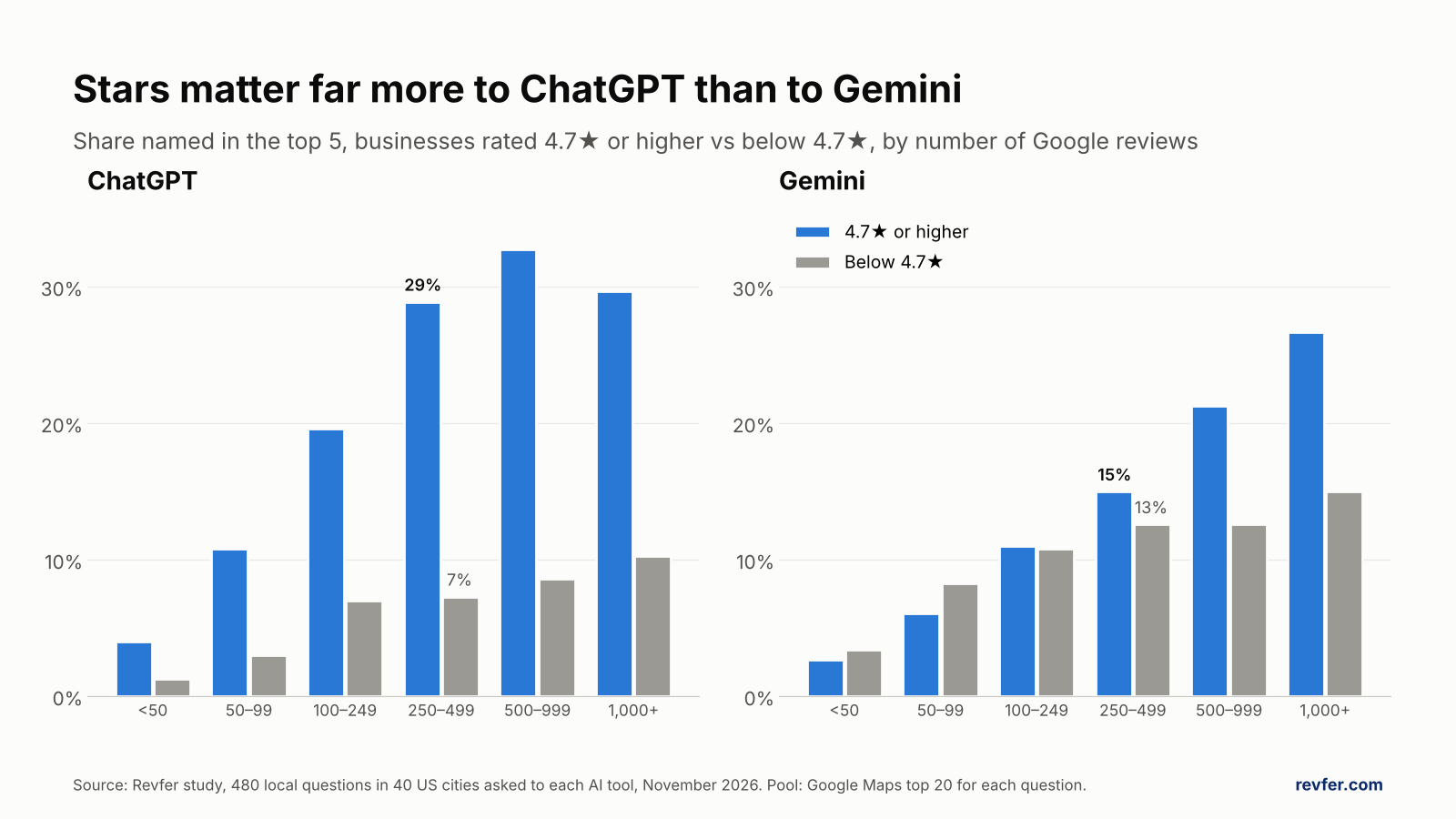
For ChatGPT, rating mattered as much as review count. Among businesses with 250 to 499 reviews, 29% of those at 4.7★ or higher were named, against 7% of those below. Google's AI tools behaved the same way: in Google's AI Overviews, businesses with 500+ reviews and 4.7★ or higher were named 42 to 44% of the time.
Gemini and Perplexity were different. For them, stars made little difference until the most-reviewed businesses, and once review count and the other features were held fixed, rating had no measurable effect for Gemini and only a small one for Perplexity. In short: ChatGPT and Google filter on stars; Gemini and Perplexity mostly on volume.
3. Freshness: A Review This Week Beats One Last Year
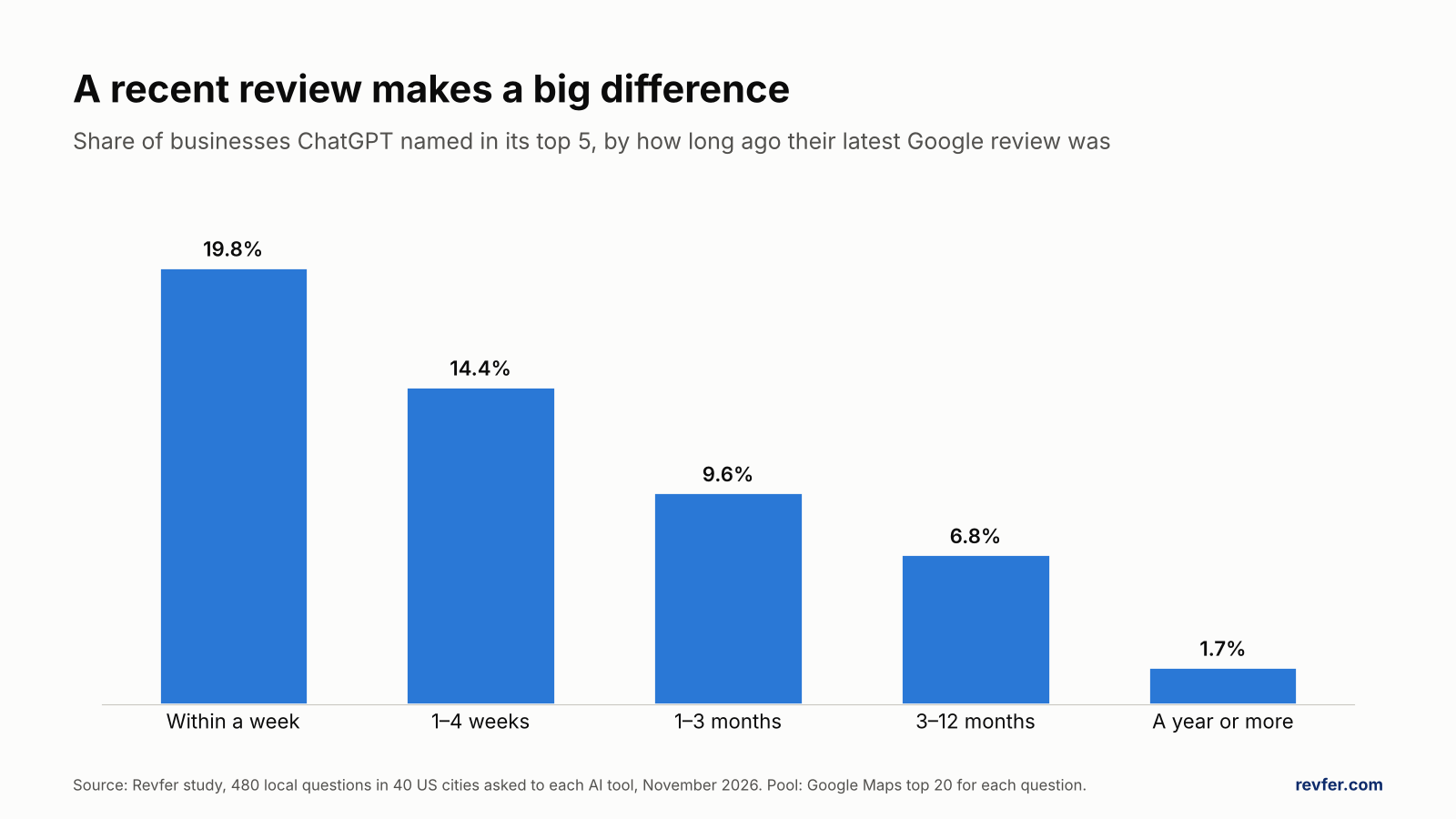
A business whose latest review was under a week old was named by ChatGPT almost 20% of the time. One whose latest review was a year or more old: under 2%. The same pattern held for every AI tool, and it held up in the model after accounting for review count. A steady flow of new reviews looks like a business that is open, busy and current.
4. The Businesses Every AI Names vs the Ones None Do
Some businesses were named by three or more AI tools for the same question. Others sat in Google Maps' top 20 and were never named by any. Here is how they compare:
| Named by 3+ AI tools | In Maps top 20, never named | |
|---|---|---|
| Median Google reviews | 488 | 101 |
| Median rating | 4.8★ | 4.8★ |
| Days since latest review (median) | 5.5 | 22 |
| Photos (median) | 158 | 33 |
| Owner replies to recent reviews (median) | 30% | 14% |
| Has a website | 97.5% | 81% |
| Businesses | 641 | 7,149 |
The median rating is the same, 4.8★, in both groups. Stars alone don't separate the businesses AI names from the ones it ignores. Volume and recency do: the consensus picks had almost five times as many reviews, and their latest review was days old rather than weeks.
5. What Mattered Less Than You Might Think
- Replying to reviews. Recommended businesses replied more often, but once review count and freshness were accounted for, replying had no separate effect on being named. Businesses that reply also tend to get more and fresher reviews, and that is what tracked with recommendations. Replies still matter to the people reading them, especially on negative reviews; see our guide to responding.
- Photos and booking links. Photos had a small effect; booking links none.
- A claimed Google profile. Linked to about 1.7 times the odds for ChatGPT and Gemini, though with wide margins. Almost all recommended businesses had claimed their profile.
- A website. It mattered for Gemini (about 2.25 times the odds) and for Google's AI Overviews, but made no measurable difference for ChatGPT once other things were equal.
- Being a chain. ChatGPT and Google AI Mode leaned clearly toward independent businesses: chains made up 1.3% of ChatGPT's picks, against 3% of the Maps top 20.
AI Picks From the Same Pool as Google Maps, in a Different Order
AI tools rarely put Google Maps' #1 at the top: ChatGPT's first pick matched Maps' first only 4% of the time. They also range wider across a city than the Maps results we compared against. But within the same area, most of their picks (76 to 90%, depending on the tool) were businesses from the Maps top 20. AI isn't finding hidden gems. It is choosing among the same well-reviewed businesses, in its own order.
And that order changes. When we asked 100 of the questions again a day or two later, ChatGPT kept the same first pick 60% of the time, Gemini 43% and Google AI Mode 40%. There is no fixed AI ranking to game. Showing up consistently means being a strong candidate every time someone asks.
What This Means for Your Business
The businesses AI recommends look like this: hundreds of Google reviews, 4.7 stars or better, and a review in the last week or two. None of that can be faked, and we wouldn't suggest trying. But all of it follows from things a good business already does:
- Ask every happy customer for a Google review. A steady trickle matters more than a burst: recency counts as well as the total.
- Protect your rating. Fix problems quickly, and reply to unhappy customers so the next reader sees how you handle them. Our guide to responding to negative Google reviews can help.
- Keep your Google profile complete and current: claimed, with a website, accurate hours and real photos.
- Check what AI says about you. Ask ChatGPT, Gemini and Google for the best business like yours in your town, and see who comes up.
What This Looks Like With Revfer
Revfer can't make an AI recommend you, and nobody honestly can. What it does is take care of the work that keeps a business active and well-regarded online: it drafts a reply to every new Google review in your voice, and writes and publishes regular Facebook and Instagram posts about your business, all on your approval. That leaves you more time for the part that matters most: serving customers well and asking them to say so.
Keep your business active online: start free →
How We Measured It
We asked one plain question per city and industry, for example "What are the best hair salons in Tulsa?" or "Can you recommend a good dentist in Boise, ID?", in 40 US cities (10 large, 15 mid-size and 15 small, across all four census regions) and 12 industries: hair salons, nail salons, barber shops, restaurants, coffee shops, dentists, chiropractors, gyms, auto repair, plumbers, pet groomers and tattoo shops. Each question went to ChatGPT, Gemini, Perplexity, Google AI Mode and a normal Google search (its AI Overview, shown for 44% of these questions, and its Maps 3-pack), logged out, in US English, from the city centre, between November 5 and 7, 2026. We matched about 95% of the businesses named to their Google listing.
For each question, Google Maps' top 20 for the same search formed the comparison pool. A business counts as "recommended" if a tool named it in its first five. The threshold tables are simple shares; the "holding other features fixed" results come from a logistic regression that compares each business only with its competitors for the same question. Listing features (rating, review count, photos, claimed status, website, booking link) and each business's newest 20 Google reviews were collected on November 6 and 7, 2026; we kept only counts and dates from the reviews, never their text or anything about reviewers.
Limits to keep in mind: this is one week of answers, from logged-out users; signed-in users, other wording or a neighborhood instead of a city can give different answers, and these tools change often. The results show correlation, not cause. A share of the names AI tools gave couldn't be matched to a Google listing, often because they were individual practitioners inside a shop; those are left out. "Industry" means how we asked. All figures are aggregates; no business is named. The aggregate results are available at doi.org/10.5281/zenodo.24089202.
Sources
- Revfer study of AI recommendations for local businesses: 480 questions in 40 US cities and 12 industries, asked to ChatGPT, Gemini, Perplexity and Google, November 2026. Aggregate results: doi.org/10.5281/zenodo.24089202
Frequently Asked Questions
How does ChatGPT decide which local businesses to recommend?
We cannot see inside ChatGPT, but we can see which businesses it names. In our study of 480 local questions in 40 US cities (November 2026), the strongest predictor of being named was the number of Google reviews. Rating mattered a lot too: for ChatGPT, businesses rated 4.7 stars or higher were about three to four times as likely to be named as businesses with a similar number of reviews below 4.7. Businesses with a very recent review were also named far more often.
How many Google reviews do you need to be recommended by AI?
There is no fixed number, but in our data the chance of being named by ChatGPT climbed steeply up to about 250 reviews and then levelled off. Businesses with 250 or more reviews were about six times as likely to be named as those with fewer than 50. The businesses named by three or more AI tools had a median of 488 reviews.
Do ChatGPT, Gemini and Perplexity recommend the same businesses?
Often not. The average overlap between two tools' top five was only 13 to 27%. Still, in 72.5% of questions at least one business was named by three or more of the four main AI tools. Those shared picks had many reviews and recent ones.
Does replying to Google reviews help you get recommended by AI?
Not directly, in our data. Businesses that AI recommended replied to reviews more often (30% of recent reviews vs 14%), but once review count and freshness were accounted for, replying had no separate effect. Replies still matter to customers, who read them when deciding where to go.
Does my website matter for AI recommendations?
It depends on the tool. Having a website was linked to about 2.25 times the odds of being named by Gemini, and Gemini often cites businesses' own sites. For ChatGPT, a website made no measurable difference once other factors were held fixed; ChatGPT mostly cites directories and review sites instead.
Is there a way to guarantee my business is recommended by AI?
No. AI answers change from day to day: when we asked 100 questions again a day or two later, ChatGPT kept the same first pick only 60% of the time, and Google AI Mode 40%. What our data shows is what recommended businesses tend to look like, not a switch you can flip.
About Pankaj Aggarwal
Pankaj Aggarwal is the founder of Revfer. He has spent more than 20 years building enterprise software and IoT systems and holds more than 10 US patents. He writes about how small businesses can put AI to work without having to become AI experts.